



- Published on: 2026-03-10 19:31:00
Failure to Respect Higher Timeframe Levels: Why HTF Supply, Demand, and Liquidity Zones Always Dominate
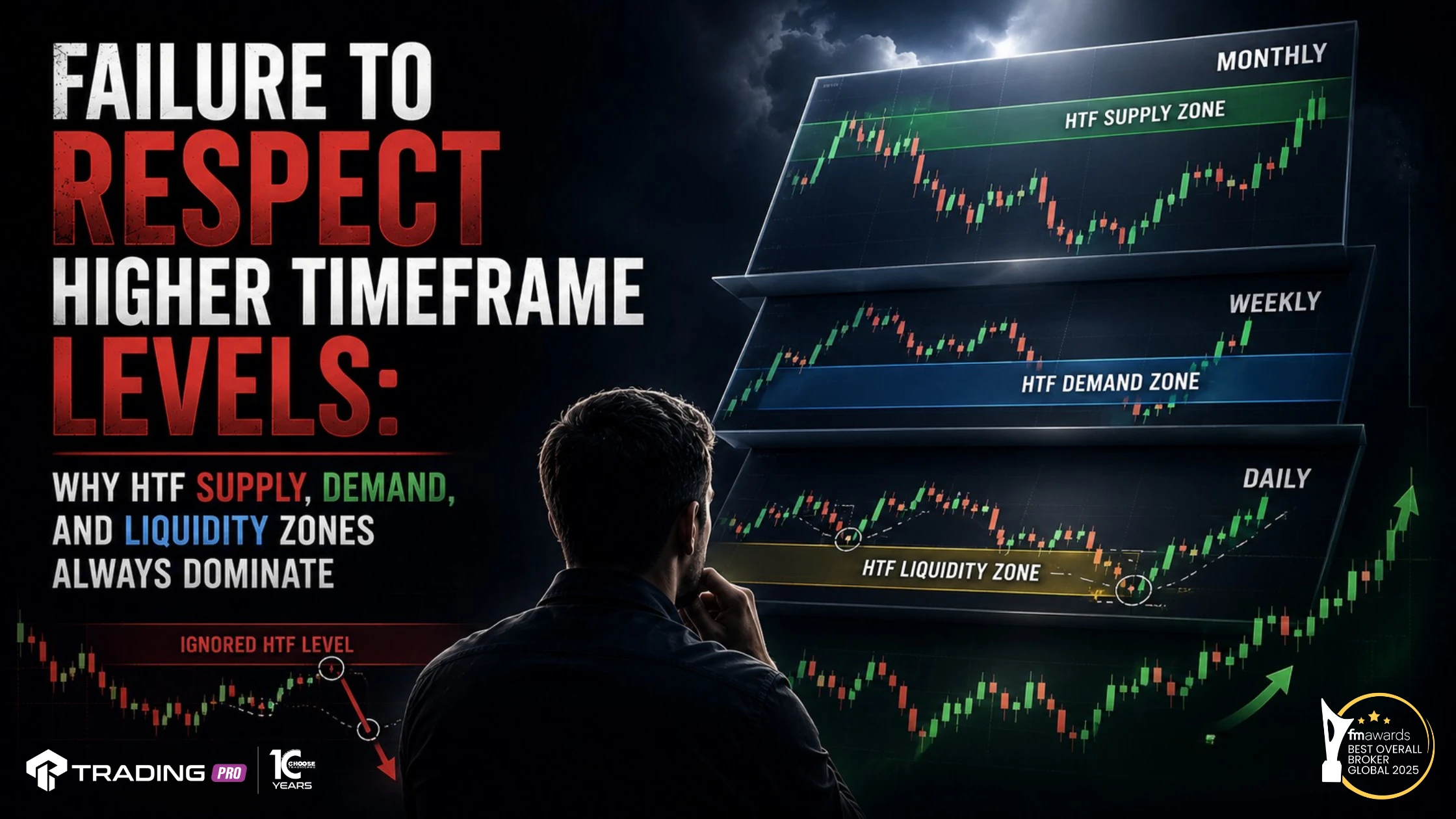
One of the most expensive lessons in forex trading is also one of the most universal: higher timeframe levels always dominate lower timeframe setups. Ignoring higher timeframe supply and demand zones, or failing to account for where major liquidity pools sit, is one of the fastest and most reliable ways to sabotage an otherwise well-constructed trading strategy.
Many retail traders invest the majority of their focus into lower timeframes — the 5-minute, 15-minute, or 1-hour charts — searching for precise entries using technical indicators and price action patterns. What they consistently overlook is that the real decision-making power in the forex market does not live on those timeframes. It lives on the 4-hour, daily, and weekly charts — and understanding that distinction changes everything.
Why Higher Timeframe Levels Carry So Much Weight
The forex market is driven largely by institutional participation — banks, hedge funds, proprietary trading firms, and large financial institutions managing capital at a scale that dwarfs anything a retail trader deploys. These participants do not build and unwind positions from a 5-minute chart. They execute around major higher timeframe supply and demand zones, key structural levels, and liquidity areas that have formed over days, weeks, and sometimes months.
When price approaches a daily supply zone, the strength of a 15-minute bullish setup becomes largely irrelevant. Institutional order flow can overwhelm short-term momentum in a matter of seconds — and frequently does.
Higher timeframe levels represent:
- Areas of institutional accumulation or distribution where large capital previously entered or exited
- Major liquidity pools where stop-losses from retail traders cluster in predictable concentrations
- Psychological support and resistance levels that the broader market is collectively aware of
- Zones with a demonstrable history of sharp, sustained price reactions
These zones are not random occurrences. They are the footprints of large capital — and price respects them because the participants who created them are still there.
The Real Cost of Ignoring HTF Supply and Demand
Failure to respect higher timeframe levels produces a predictable and recurring set of consequences:
- Counter-trend trading directly against dominant institutional momentum
- Getting stopped out at obvious liquidity grabs, precisely where the market is engineered to reach
- Overtrading within what is actually a larger consolidation or distribution range on a higher timeframe
- Consistently poor risk-to-reward execution driven by a lack of contextual awareness
A common and painful example: a trader identifies a bullish breakout on the 15-minute chart and enters long with conviction — completely unaware that price is simultaneously approaching a weekly supply zone. The market taps into that higher timeframe liquidity, reverses sharply, and stops them out. The lower timeframe setup was not necessarily wrong. It was simply positioned in the wrong context.
In professional forex trading, context is not a secondary consideration. It is everything.
Liquidity Zones: Understanding What Actually Drives Price
Liquidity drives price. Market makers and institutional participants need liquidity to fill large orders — and that liquidity does not exist randomly across the chart. It sits in specific, predictable locations: above equal highs, below equal lows, and around the obvious support and resistance levels that the majority of retail traders are watching and placing orders around.
Higher timeframe liquidity zones carry dramatically more weight than lower timeframe ones. When a daily equal high forms, price will eventually target that liquidity — not as a coincidence, but as a function of how the market is structured. Retail traders who place stop-loss orders above that high are, without realising it, providing the fuel for institutional entries.
Developing a genuine understanding of where higher timeframe liquidity sits improves every dimension of trading execution: entry timing, stop-loss placement, market structure analysis, and risk management decisions.
The shift in questioning that this understanding produces is significant. Instead of asking "Is this a good entry?", experienced traders ask: "Where is the higher timeframe liquidity most likely to be targeted — and am I positioned on the right side of that move?"
Top-Down Analysis: The Professional Approach
A consistent, professional forex trading strategy does not begin on the 15-minute chart. It begins at the top of the timeframe hierarchy and works methodically downward:
- Start with the weekly chart to establish macro trend direction and identify the dominant structural bias
- Mark daily supply and demand zones that price is likely to respect or react from
- Identify 4-hour liquidity pools and market structure shifts that provide intermediate context
- Drop to lower timeframes only once the higher timeframe narrative is clearly mapped — using them for refined, precise entries that align with the broader picture
This top-down approach ensures that lower timeframe execution is always working in the same direction as higher timeframe intent. When lower timeframe setups align with HTF bias, probability increases substantially. When they conflict with it, discipline requires stepping aside — regardless of how compelling the short-term signal appears.
Patience, applied within this framework, becomes a genuine competitive advantage.
Risk Management and HTF Awareness
Higher timeframe analysis does not just improve entry quality — it strengthens every element of risk management. Entering a trade near a major HTF level requires deliberate adjustments to position size, stop-loss distance, profit targets, and overall trade expectations. Applying the same risk model regardless of higher timeframe structure is a fundamental error.
For example, entering a short position inside a daily demand zone requires tighter risk control and reduced position sizing, because probability at that location favours a potential bounce. Conversely, entering in the direction of a confirmed HTF bias with clear confluence allows for more confident position sizing and meaningfully improved risk-to-reward ratios.
Structure-aware risk management is not just more precise — it is more profitable over time.
The Psychology Behind Ignoring Higher Timeframes
Failure to respect higher timeframe levels rarely stems from ignorance alone. More often, it stems from impatience. Lower timeframes offer more signals, more price movement, more stimulation — and for traders susceptible to what might be called signal addiction, that activity creates the illusion of opportunity where none exists in the broader context.
Respecting HTF supply and demand forces a slower, more deliberate approach to the market. It requires strategic planning before execution, discipline when lower timeframe signals conflict with higher timeframe structure, and the emotional control to wait for genuine confluence rather than forcing trades that feel compelling but lack contextual backing.
These are not comfortable habits to build. But they are the habits that underpin long-term profitability.
Final Thoughts
In the forex market, higher timeframe supply and demand zones and liquidity areas dominate price behaviour. No indicator, candlestick pattern, or short-term breakout can consistently override major institutional levels — and the traders who try to do so will discover that reality at the cost of their capital.
If you want to elevate your trading performance, the path is clear: prioritise top-down analysis, map higher timeframe liquidity before committing to any entry, align lower timeframe execution with HTF bias, and integrate disciplined, structure-aware risk management into every trade you take.
The market rewards traders who respect structure. It punishes those who ignore context.
And always remember: the lower timeframe shows you the opportunity. The higher timeframe reveals the intent.
Stop trading setups without context — start reading the market from the top down.
Join the TradingPRO community and get access to daily market analysis, trading psychology guides, and strategy breakdowns — completely free.
Facebook | Instagram | Telegram | LinkedIn | Twitter (X)


